
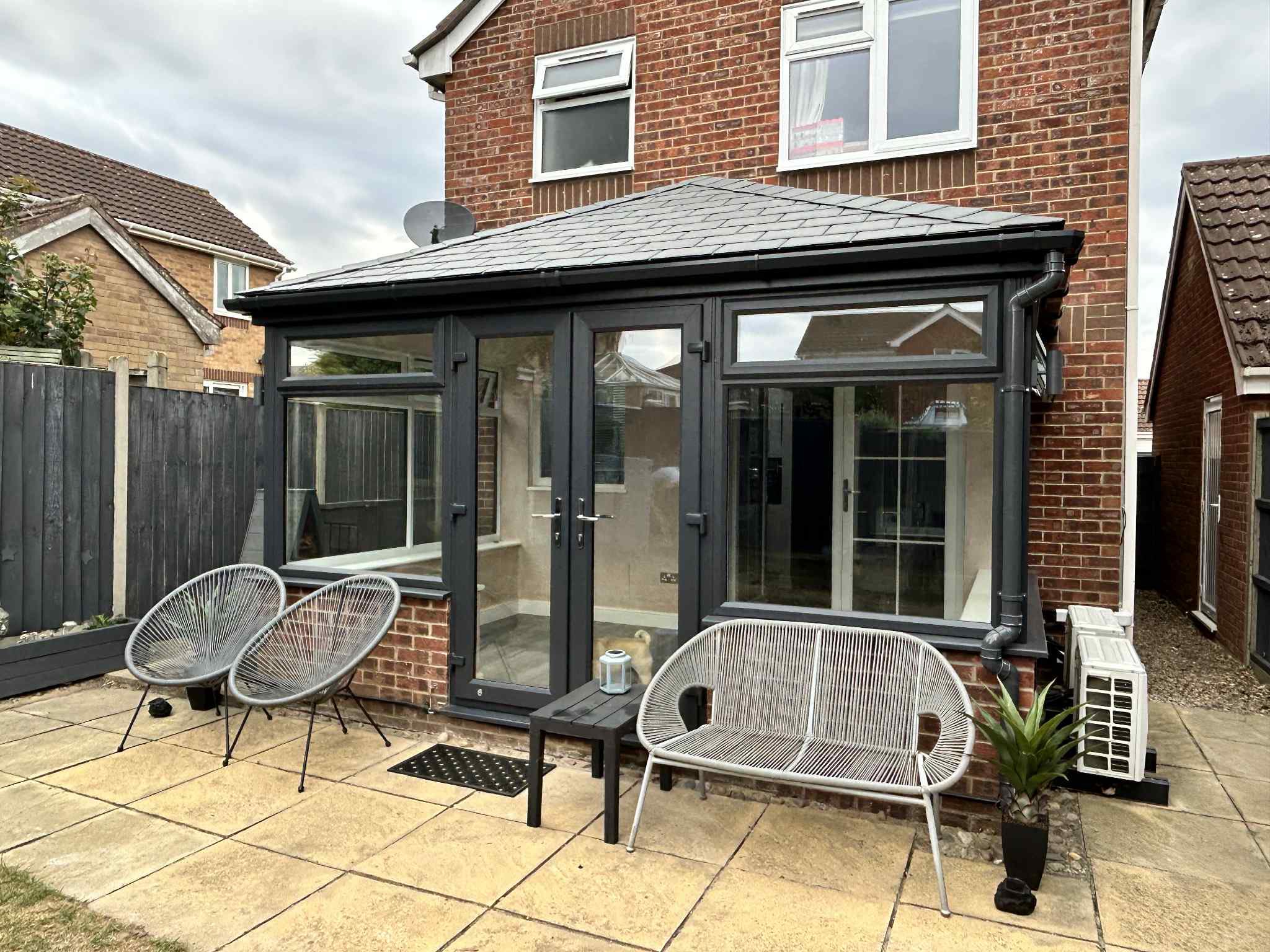
Most likely, yes. If you’re replacing a glass or polycarbonate conservatory roof with a solid one, building regulations will almost always apply, and you’ll want the certificate to prove the work was done properly. Here’s what that means in plain terms, why it matters, and how we keep it straightforward.
Planning permission and building regulations aren’t the same thing
This trips a lot of people up, so it’s worth being clear. They’re two separate things, handled by two separate teams at your council.
- Planning permission is about whether you’re allowed to build something, and how it looks and affects your neighbours. Replacing a conservatory roof usually doesn’t need it, as the work normally falls under permitted development.
- Building regulations are about whether the work is safe and built to standard, covering structure, insulation, ventilation and fire safety.
The government’s official Planning Portal puts it simply: a new conservatory roof must comply with building regulations to make sure it’s structurally safe, energy efficient and properly ventilated. So even when you don’t need planning permission, you can still need building regulations sign-off.
Why a solid roof changes things
A glass or polycarbonate conservatory is often exempt from building regulations, but only if it ticks a specific set of boxes. Broadly, the conservatory has to sit at ground level, be under 30 square metres, be mostly glazed (at least half the walls and around three-quarters of the roof), be separated from the house by external doors or windows, and run on its own heating rather than an extension of the main system.
The moment you fit a solid roof, you usually break that exemption. The roof is no longer mostly translucent, and a tiled roof is far heavier than the glass or plastic it replaces. In the eyes of the rules, the space starts to behave like an extension rather than a conservatory, so it has to meet the same standards as one.
What building control actually checks
When your roof is signed off, the inspector is mainly looking at three things:
- Structure — can the existing conservatory walls and base safely carry the extra weight of a solid roof?
- Thermal performance — does the roof meet the required insulation standard, a U-value of 0.15 W/m²K under Part L of the regulations?
- Ventilation and safety — is the room properly ventilated to avoid condensation and damp, and are the fire and safety requirements met?
Pass on all three and you receive a completion certificate confirming the work meets the regulations.
How the certificate is obtained, and how we speed it up
There are two routes to that certificate. The first is to have the roof built and then inspected by your local authority’s building control team. The second is to fit a system that has already been assessed and pre-approved by a Registered Building Control Approver — a private body that carries out the same role as the council’s building control.
The Aura roof system is fully approved by MFA Building Control, one of the longer-established approvers of this kind in England and Wales. Because the system itself is already type-approved, the checks focus on confirming it has been installed correctly, rather than assessing the whole design from scratch. In practice that means less paperwork, fewer delays and a smoother path to your certificate. We’ll talk you through exactly what applies to your project during our first visit, and we always recommend checking with your local authority as well, since the finer points can vary from one council to another.
Why the certificate is worth having
It’s tempting to see all this as red tape, but the certificate genuinely protects you. When you come to sell, your buyer’s solicitor will usually ask for proof that the roof was signed off. Without it, you can face delays, the cost of an after-the-fact “regularisation” inspection, or indemnity insurance — any of which can hold up a sale. It can also matter for your home insurance if unapproved structural work ever causes a problem down the line.
The honest bit
This is also why we’d steer you away from cheap “clad-over” roofs that simply sit on top of the old one. They add weight the structure was never designed for, they rarely meet the thermal and structural standards, and they leave you without a valid certificate. Doing the job properly costs a little more, but it’s the difference between a room you can sell with confidence and a problem you’ve quietly boxed up for the next owner to find.
The bottom line
If you’re putting a solid roof on your conservatory, you’ll almost certainly need building regulations certification. The good news is that it doesn’t have to be a headache. With an MFA-approved Aura roof and an in-house team that handles this process every week, we take care of the paperwork, and you end up with a comfortable room and the certificate to prove it’s been done right.